
I often hear the same phrase in the gallery.
"I don't know what I'm looking at."
It is usually said quietly, almost apologetically, as though there is a correct answer hidden somewhere and everyone else in the room has already found it.
The truth is, they probably haven't.
We seem to believe that art, particularly abstract art, comes with a right and wrong way of looking. That if we don't immediately understand it, we've somehow failed. I don't think that's true at all. In fact, I think the pressure to understand a painting often prevents us from simply experiencing it.
The first time abstract art truly spoke to me wasn't because I understood it. It was because I felt it.
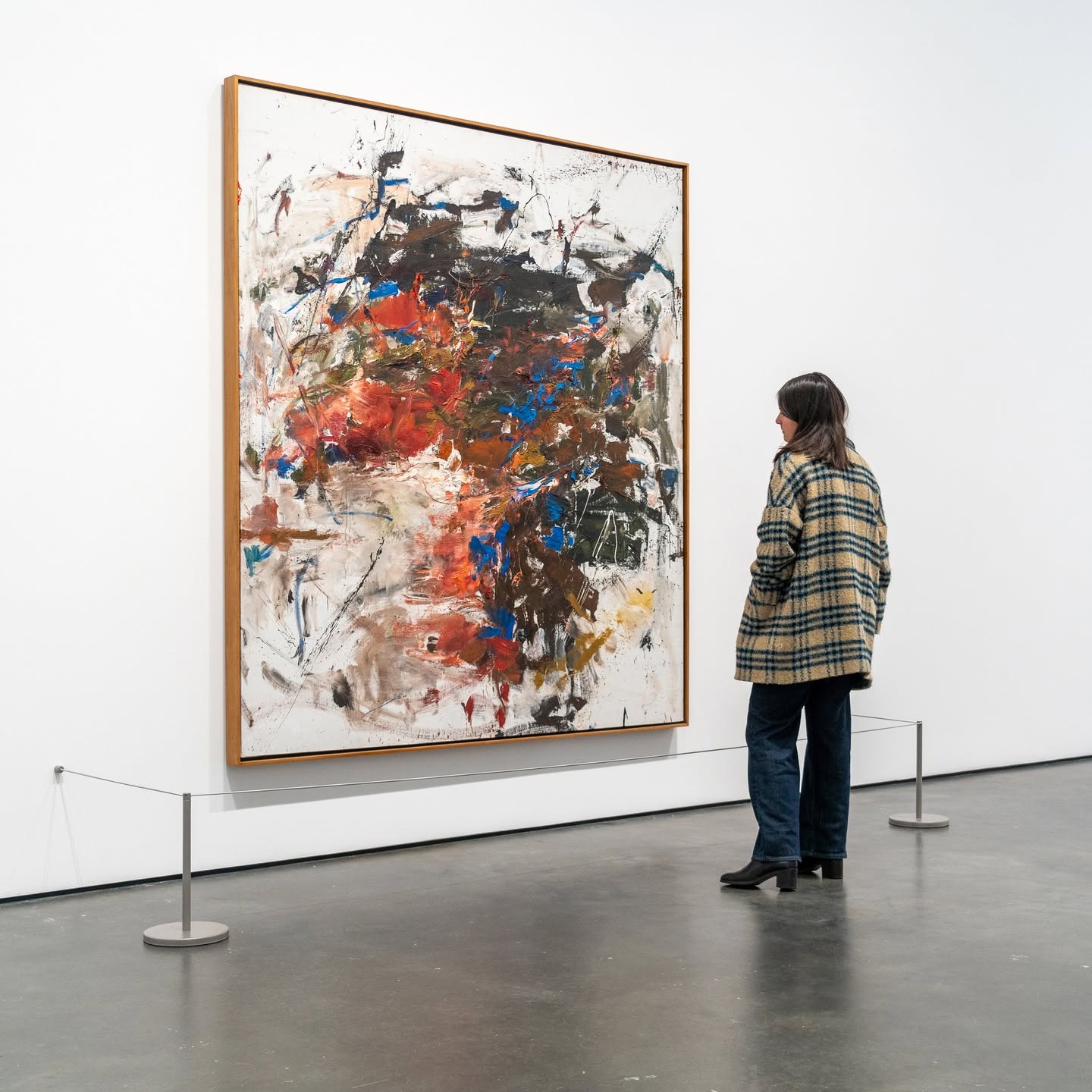
I was standing in front of Mandres by Joan Mitchell.
At the time, I knew very little about Mitchell or the circumstances surrounding the painting. I wasn't analysing composition or trying to identify influences. I simply stood there, looking. Before long, I found myself unexpectedly emotional.
The brushstrokes felt raw. There was an intensity to the painting that I couldn't explain. To me, they carried a sense of anger, urgency and immense energy. I wasn't trying to decode the work, I was responding to it.
Only later did I discover that Mandres was painted during a profoundly difficult period in Mitchell's life, after her mother had been diagnosed with cancer. Whether my response had anything to do with that context is almost beside the point. The painting had already spoken to me before I knew anything about its history.
That experience changed the way I looked at abstract art forever.
It also changed the way I speak about it.
One of the comments I hear most often in the gallery is, "My child could paint that." Sometimes it's said jokingly, sometimes sincerely. Another is, "I just don't get abstract art."
My response usually surprises people.
I tell them that I completely understand.
There are forms of art that don't naturally resonate with me either. There are paintings I admire enormously that I wouldn't necessarily choose to live with. Appreciation and personal connection are not the same thing.
The important thing, I think, is to remain curious.
Understanding why something doesn't speak to you can be just as rewarding as discovering why something does.
Perhaps that's where abstract art differs from so many other forms of painting. It asks very little of us, except that we spend time with it.
When most people stand in front of an abstract painting, the first thing their mind does is search for familiarity.
"Is it a landscape?"
"Is that a figure?"
"I can see a boat."
"It looks like a dancer."
I do exactly the same.
I think that's simply human nature. Our brains are constantly trying to make sense of what we see.
But after that initial moment, something more interesting often happens.
People begin talking.
One person sees rolling countryside.
Another sees the sea.
Someone else sees movement.
None of them are wrong.
Every one of us brings our own experiences into a painting. The places we've lived, the people we've known, the memories we carry, even our mood that particular day all influence what we see.
Someone who grew up surrounded by open fields may instinctively recognise a landscape. Someone else may see nothing of the sort.
The painting hasn't changed.
The viewer has.
That, to me, is one of the great joys of abstract art.
It creates conversations that would never otherwise happen.
Sometimes, when visitors tell me they don't know what they're looking at, I'll ask a simple question.
"Can I tell you what I see?"
Notice I don't say, "This is what it is."
I simply share my own response.
Almost immediately, they begin to offer theirs.
"I can see clouds."
"I see waves."
"I've just noticed a face."
"It's funny, I hadn't thought of that."
The conversation becomes about looking rather than being right.
For me, that's where art becomes truly interesting.
People often assume that great art needs to tell a story in precise detail.
I'm not convinced it does.
Sometimes colour alone is enough.
I've been drawn to paintings simply because of their palette. Certain colours feel calm. Others create tension. Some combinations feel optimistic, others reflective. Before we've interpreted a single brushstroke, colour has already begun affecting us emotionally.
Perhaps that's because emotion doesn't always need language.
Some people express themselves through writing.
Some through music.
Some through fashion.
For others, paint and a brush become their way of communicating. Not by describing every detail of an experience, but by expressing its emotional weight.
That is something realism and photography cannot always do.
The paintings I continue returning to are rarely the ones I completely understand.
They're the ones that stay with me.
The ones that reveal something different six months later.
The ones that seem to shift depending on how I'm feeling that day.
I think that's why people collect original art.
Not because they hope it will be worth more in ten years' time, although sometimes it might be. The collectors I most enjoy meeting buy paintings because they want to live with them. They want to wake up, walk past them every day and discover something they hadn't noticed before.
The relationship evolves.
The painting doesn't change.
We do.
That is one of the reasons Ian Rayer-Smith's paintings resonate with so many people.
His work doesn't ask the viewer to find a hidden meaning or solve a visual puzzle. It invites them to spend time with it. Colour, movement and atmosphere become the starting point, leaving space for each viewer to bring something of themselves to the experience.
No two conversations are ever quite the same.
And perhaps that's exactly as it should be.
The next time you find yourself standing in front of an abstract painting, resist the temptation to ask yourself whether you're looking at it correctly.
Instead, ask a simpler question.
"What does this make me feel?"
You may never arrive at a single answer.
Then again, perhaps that was never the point.
Add a comment